Volatility as the new normal: Managing bullwhip in the modern era
Volatility is no longer an exception in supply chains, it is the operating reality. Geopolitical shocks, climate disruptions and policy uncertainty are no longer isolated events, but recurring patterns that continuously disrupt global flows. As a result, the Bullwhip Effect is no longer a side effect of poor coordination: it has become a defining reality of modern supply chains.
Yet most supply chains are still designed for stability: optimized for cost, lean inventories, and tightly synchronized planning. This structural mismatch is increasingly exposed under persistent volatility. The critical question for supply chain leaders is therefore not how to respond to the next disruption, but how to redesign systems to perform under continuous disruption.
In this article, we will focus on the three actors in the supply chain: the retailer, the manufacturer, and the raw material supplier. Each actor faces different challenges, so for each actor we break down the key learnings and defining features of a future-proof supply chain.
The retailer
Retailers sit at the front line of the supply chain, translating consumer demand into replenishment signals that drive the entire system. In stable conditions, this role is relatively straightforward. In a volatile environment, however, even small shifts in demand can quickly cascade upstream, reinforcing the Bullwhip Effect.
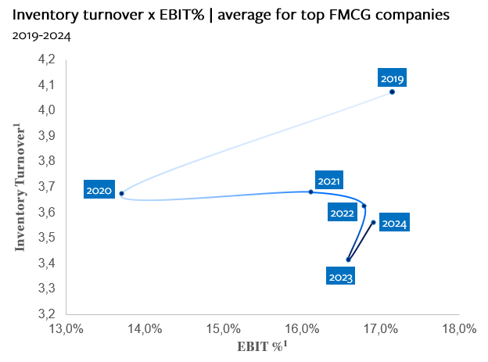
Recent years have shown how easily this dynamic can get out of control. Faced with uncertainty, many retailers reacted with over-ordering to protect availability, followed by sharp corrections when demand normalized - creating cycles of shortages and excess. At the same time, leading retailers have pushed for higher inventory turnover since 2019 as shows in the figure below, tightening inventory positions after the pandemic-driven build-ups.

While this shift has improved efficiency, it also reduces the system’s ability to absorb shocks. Higher inventory turnover means lower buffers and faster reactions to demand changes, making supply chains more sensitive to short-term fluctuations. In effect, retailers have become more responsive - but also more exposed to amplifying volatility.
The implication is clear: the role of the retailer needs to evolve. It is no longer just about reacting to demand, but about actively managing and stabilizing the signal sent upstream - through better use of real consumption data, more disciplined ordering, and greater transparency with suppliers.
What this means in practice (Retailer playbook)
Design for optionality with multi-sourcing
Prioritize real demand over forecasts by leveraging POS data
Be disciplined in ordering behaviour (e.g. limiting excess volume)
Align commercial and supply chain decisions (e.g. through S&OP, merchandise planning and promotion planning))
Increase inventory transparency with suppliers through EDI or API
Use buffers deliberately in the exposed areas, not reactively
The manufacturer
Manufacturing companies sit in the middle of the supply chain, translating retail demand into production and supply plans. Unlike retailers, they are not just passing on demand signals - they are responsible for absorbing variability and ensuring continuity of supply. In a volatile environment, this makes their role fundamentally different: where retailers risk amplifying demand swings, manufacturers are expected to dampen them.
In practice, this has proven to be challenging. Faced with the same disruptions, many manufacturing companies experienced significant swings in production and inventory - first reacting to surging retail orders, then adjusting to sudden slowdowns. This reflects their position in the chain: they are directly exposed to the amplified signals coming from downstream, while also dealing with constraints upstream.
The data shows a different pattern compared to retail. Inventory turnover has structurally decreased, reflecting an intentional stock build up. This highlights a key distinction: while retailers have moved towards leaner, faster systems, manufacturing companies have had to retain more buffering capacity to cope with volatility.
The implication is that manufacturing supply chains must be designed to absorb and smooth volatility, rather than simply react to it. This requires greater flexibility in production, better alignment with retail partners, and more adaptive planning processes that can respond to changing conditions without overcorrecting.
What this means in practice (Manufacturer playbook)
Build flexibility in production and sourcing (multi- and near-shoring)
Avoid overreacting to short-term demand swings by actively smoothing demand variability from retail
Strengthen collaboration and data sharing with retailers (e.g. EDI and API)
Balance efficiency with strategic buffering
The raw material supplier
Raw materials suppliers sit at the very upstream end of the supply chain. Unlike retailers or manufacturers, they are not directly exposed to consumer demand - they experience it indirectly, often with delays and significant distortion. By the time demand signals reach this stage, they have typically been amplified through multiple layers, making the Bullwhip Effect most visible - and most extreme - at this level.
This position creates a fundamentally different challenge. Where retailers risk amplifying volatility and manufacturers are expected to absorb it, raw materials suppliers must operate in an environment where demand is both highly uncertain and difficult to interpret. Recent disruptions have highlighted this clearly: sudden spikes in orders followed by rapid cancellations, limited visibility into true end demand, and significant swings in capacity utilization.
At the same time, raw materials supply chains are typically more rigid. Production is often capital-intensive, lead times are long, and flexibility is limited. This makes it difficult to respond quickly to changing conditions, increasing the risk of either undercapacity during demand surges or costly overcapacity during downturns.
The implication is that raw materials suppliers need to focus less on reacting to short-term demand signals, and more on managing structural uncertainty. This includes building stronger collaboration with downstream partners, improving visibility where possible, and making more deliberate capacity and allocation decisions to avoid being caught in extreme cycles.
What this means in practice (Raw materials playbook)
Focus on long-term demand signals over short-term order volatility
Strengthen visibility and collaboration with downstream partners (e.g. EDI and API)
Build optionality in capacity and sourcing where possible
Use allocation and prioritization mechanisms during peaks
Avoid overcommitting capacity based on temporary demand spikes
Bracing for volatility starts today
The common thread across retailers, manufacturers, and raw material suppliers is clear: volatility cannot be eliminated, but its impact can be managed. This requires a fundamental shift, from reacting to disruptions to structurally bracing for volatility.
Future-proof supply chains will not be those that are the most efficient in stable conditions, but those that are deliberately designed to absorb, interpret, and stabilize volatility across the chain. Organizations that embrace this shift, through disciplined decision-making, smarter use of signals, and clearer roles across the chain, will not only reduce the Bullwhip Effect, but turn resilience into a competitive advantage in an increasingly unpredictable world.
The good news: this shift does not require a complete redesign overnight. It starts with a few focused choices that improve your supply chain resilience step by step. But with the next disruption always around the corner, the real risk is not moving too fast: it’s waiting too long to start.
Authors: Joeri Spoor and Freek Schothorst
Curious about how IG&H can help you get ahead? Let’s get in touch!

Joeri Spoor
Senior Manager Digital Supply Chain
T: +31623193876